We are so blessed having lovely September days above 20 degrees Celsius in September.
I had booked my "usual" flying lesson time of Sunday 10am, which gives me time to go to church for 8.30 then drive to Shoreham Airfield for a 10am lesson. This is good for me as I skip breakfast, lift blood sugar slightly with white coffee, and have low risk of hypo from insulin during the flight as I haven't had any fast insulin since dinner the night before.
Today we would be practicing setting up aircraft config for the Base Leg and then Final as we head towards doing take-off and landing circuits part of training in a few weeks time (I hope). We headed off towards the Isle of Wight practicing last week's climbs, then I did a 180 degree turn to head back towards Shoreham and our Base and Final leg practices. Here's that 180 degree turn through my GoPro mounted on my shoulder...
Base leg config is carb heat on, set 1500 RPM, hold nose up until speed drops below 100 kts, add 2 stages of flap in quick succession whilst keeping pitch consistent, set pitch for 75 kts, then on Final (normally as you turn to line up with runway) add third stage of flap and trim for 70 kts. I then praticed "going around" - full power, remove 3rd stage of flap, carb heat off, check positive climb, remove next two stages of flap. Here I am practicing those maneuvers...
Then near Shoreham my Flying Instructor asked me to do the real turn onto Final for the first time and get in Final config (3rd stage of flap, pitch for 70 kts), before he took over, lost a lot of height as I was high, and made a great cross-wind landing...
This was a really enjoyable flight, and I feel like the aircraft is doing what I want more than me "riding it".
Here's a chart of our flight...
Weather...
- EGKA 280820Z 02005KT 9000 0700E BCFG FEW001 14/14 Q1021
- At 08:20 GMT on 28th (September) wind 20 degrees at 5 kts, visibility 9000 but just 700 to East, Patches of fog, a few clouds at 100 ft. Temp 14 degrees, dew point 14 degrees. Barometric pressure 1021 hPa.
Blood sugar readings...
> 2 hours before flight: 5.8
< 30 mins before flight: 7.0
Landing: I didn't test before landing as I wasn't doing the flying for this part of the flight
(I did check check back in terminal after landing and blood sugar was 6.2)
Flying hours...
This flight: 1h 5m
Accumulated: 6h 15m
I was blessed with a beautiful sunny Sunday morning for my 5th flight. I got up around 6.30am to watch a great webcast of a SpaceX launch to the International Space Station (geek!), swotted up on my lesson notes for today's flight, went to my local church for 08.30 Communion service, then straight off to Shoreham to fly at 10am.
Morning flights work well for me as it's easy to miss breakfast and therefore avoid injecting insulin and the dangers that brings. My blood sugars on waking were 6.3 which is fine for first thing. By the time I got to the airfield I had drunk a large tea, and two coffees - all with milk - and the lactose in the milk plus the carbohydrate in the Eucharist wafer had lifted my blood sugar to 9.1 which is quite high. However the CAA like blood sugars to be a little high as it's safer for flying so I was happy with that.
It's interesting - for best health I would target blood sugars of between 5 and 6. But to fly you need blood sugars between 5 and 15. As hypos are dangerous I aim to fly with blood sugars between 7 and 9 so I guess flying isn't going to be "good" for me. To be honest I think it's blood sugars above 10 for long periods of time that cause real complications so I don't think I need to worry about having slightly higher blood sugars while flying than I would otherwise target.
My Flying Instruction (FI) met me in the terminal and while he checked out another plane for a later flight, I did the Cockpit Preparation and External Inspection checks on the Piper Warrior that I would be flying. I will make a video of this for you soon as it's quite interesting.
Winds were from the East so we would be using hard runway 02. This is quite a long taxi away from the standing area, and my FI let me do pretty much the lot. Taxiing is quite fun but steering using toe-brakes takes some getting used to. Here's a video of that taxi...
With the FI at the controls we took off towards the East, turned left, and climbed to 2,000 ft heading towards the Isle of Wight. Today I would be learning about climbing and descending. That's not as simple as it sounds - especially if you want to do it safely and smoothly. We went up in stages of 1,000 ft eventually reaching 10,300 ft over the Isle of Whight. We turned around then did gliding and powered descents back towards Worthing Pier where the FI took over for the landing.
To climb you follow the routine P-A-T... Power, Attitude, Trim. So from straight and level with engine at 2,300 RPM you do a good scan of the sky especially above the aircraft, check mixture is rich, increase to full power while countering the resulting yaw with rudder, and the nose naturally comes up. Pull back on the stick until the speed drops back and stabilises at 75 kts. When all is settled you trim the aircraft using the trim wheel between the seats so you are not having to pull back on the stick any more. Every 500 ft we need to check that the way ahead is clear as the aircraft nose is blocking the view. We alternated the two commonly-used ways to do this - drop the nose and have a good scan, and turning left then right then back to centre. Dropping the nose gave the best visibility in my view.
To level out from the climb you follow the routine A-P-T... Attitude, Power, Trim. You push the stick forward so the nose comes down, and watch the speed start to increase back towards cruise speed of around 95 kts. You then drop the throttle back to 2,300 RPM using the rudder to counter the resulting yaw, and stabilise the aircraft using the trim wheel.
Here's a video of me trying to do that smoothly while turning to avoid clouds as we pass through 3,000 ft...
We were very blessed with the weather, and for the first time while flying I saw airliners high above me at between 20,000ft and 30,000ft shining brightly in the clear blue sky. We got up to 10,300 ft which is twice as high as I have flown before. The climb was getting harder and harder as we got higher and the air got thinner - in other words at max power while holding the same airspeed of 75 kts our vertical climb rate was getting smaller the higher we got.
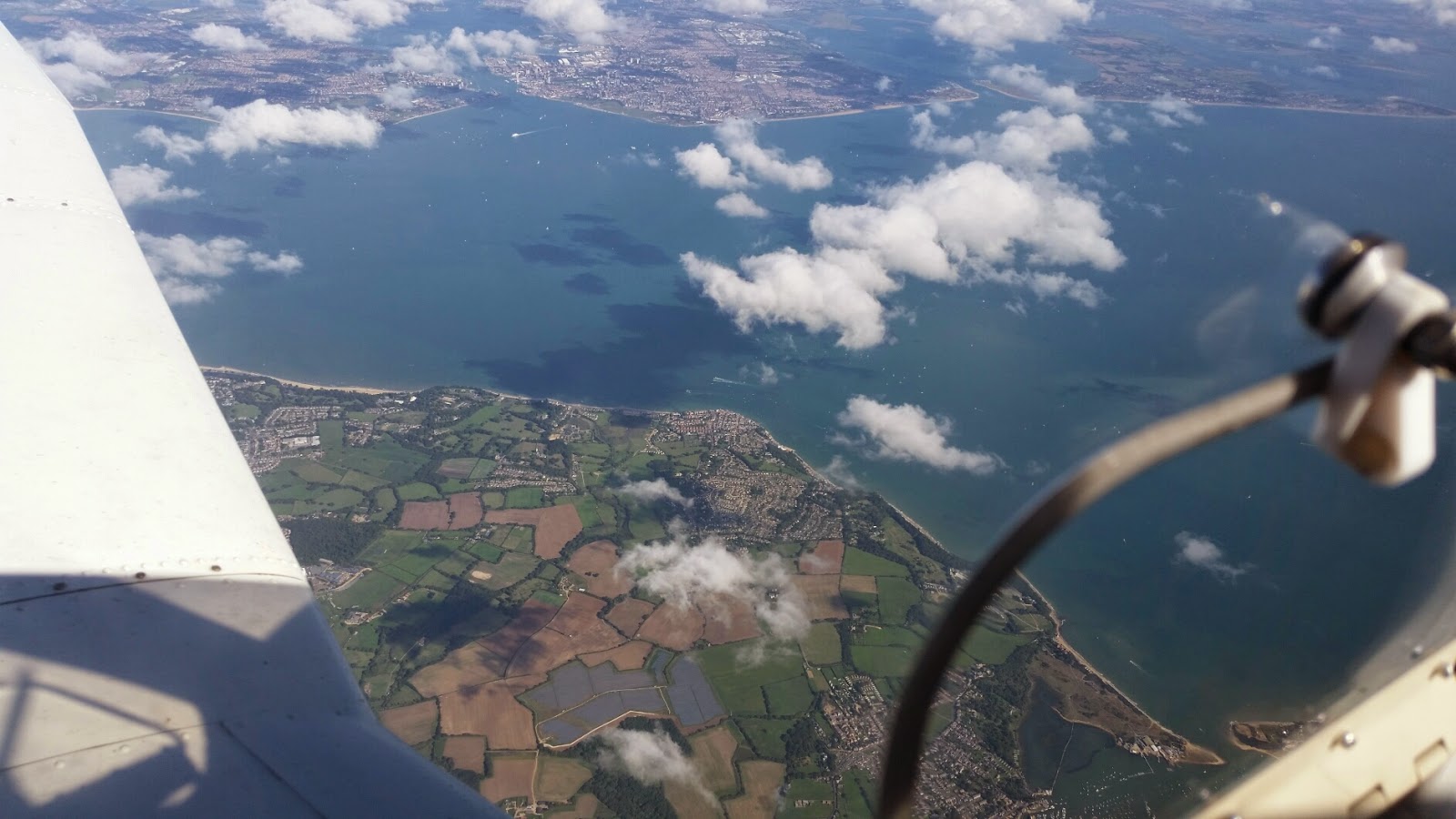
High above Bembridge on the Isle of Wight we turned around, and I managed to get some nice pics out of the window including Bembridge Harbour (bottom-right corner of first picture) where as a child I slept on my parent's boat many times...
Next I learned about gliding descents which is a descent with the engine at idle. It's not quite that simple. Once again the routine is P-A-T. You make sure mixture is rich and put Carb Heat on to protect the engine from over-cooling in the cold air and low load, then reduce engine power to idle while controlling resulting yaw with rudder. Let speed drop to target speed, then lower the nose and maintain speed. Every 500 ft you need to ensure the engine is remaining hot by going to full power and then back to idle while neutralising the resulting yaw. To level out it's P-A-T again... turn Carb Heat off and apply cruise power of 2,300 RPM whilst controlling the resulting yaw with rudder, then lift the nose to neutral and trim for level flight.
Here's a video of me trying to do that smoothly - listen out for the surge back to full power then back to idle half way through the maneuver to keep the engine warm...
Finally I worked my way down to 1,600 ft over Worthing Pier by practicing the Powered Descent. This is similar to the Glide Descent except the engine is at 1,900 RPM so doesn't get too cold. This means the surges up to full power and back to warm the engine are not needed.
After the FI landed on runway 02 he let me practice taxiing using not-in-use grass runway 07 back to the parking area. On grass you taxi a slower, and keep stick back to keep weight off the nose wheel. Once again steering and stopping is by using toe-brakes. Here's a quick video of that...
This was a really fun lesson and I feel I have much better control of the aircraft now. I'm also looking out of the window much more, flying less by the instruments, and handling the aircraft on the ground now too. It was wonderful to be so high and see airliners for the first time. Our southern coastline really is a beautiful place to fly.
Here's a chart of our flight...
Weather...
- EGKA 210820Z 01012KT 9999 SCT028 17/10 Q1023
- At 08:20 GMT on 21st (September) wind 10 degrees at 12 kt, visibility 10km or greater, scattered clouds at 2,800 ft. Temp 17 degrees, dew point 10 degrees. Barometric pressure 1023 hPa.
Blood sugar readings...
> 2 hours before flight: 6.3
< 30 mins before flight: 9.1
Landing: I didn't test before landing as I wasn't doing the flying for this part of the flight
Flying hours...
This flight: 1h 10m
Accumulated: 5h 10m